Jim Linderman blog about surface, wear, form and authenticity in art, antiques and photography. Dull tool and dim bulb were the only swear words my father ever used. Items from the Jim Linderman collection of vernacular photography, folk art, ephemera and curiosities. (Note: if anyone believes an image contained violates their rights or insults their intelligence, simply point it out and I will remove)
Anyone can join in the war effort with this painted novelty photographer backdrop (actually a foreground.) Anonymous photograph Circa 1944 collection Jim Linderman You may wish to preview two related books I have published, linked below. Ebook versions are only $5.99. Thanks! Jim.
Comic Foreground Novelty Photographs from Argentina ARGENTINA TINTAMARRESQUE EBOOK $5.99 FREE PREVIEW AND ORDERS HERE
Behind the Sitter in American Tintype Photography 1860 - 1920 THE PAINTED BACKDROP EBOOK $5.99 FREE PREVIEW AND ORDERS HERE
Anything John Hubbard does is great, so this site will be well worth watching. I have no idea what he has up his designing sleeves, but it will be interesting.
Wooden carved articulated folk art figure, less then 3 inches tall. Circa 1935 or so. Collection Jim Linderman BOOKS AND EBOOKS BY JIM LINDERMAN AVAILABLE HERE
There are two types of Hula dance. just like there is two types of American Indian art. That would be Pre-Western world and Post-Western world.
The Pre-Western world Hula was an integral tradition of a great cultural, spiritual and social significance. (Again…just like Pre-Western Native American Indian art.)
The Post-Western Hula is a way for American women to discover their hips. Or to look coy. Or to ham it up for their hubby. Or, now that I think of it…a way to be slightly offensive to a culture which spread from Tahiti to New Zealand, with hula hotspots in Hawaii, Somoa, Tonga and other locales.
The Post-Western world American Indian art was produced for sale, at slave wages, by people transitioned to reservations in need of a survival income.
Okay…factual but unfortunate history lesson out of the way. No, wait. It gets worse.
When Protestant missionaries arrived in the Hawaiian islands, they immediately found the traditional dance obscene. First step of learning the Hula? BAN it. By the time of our Civil War, the missionaries had managed to nearly stamp out the Hula on the islands, and believe it or not, LICENSED it so when it occurred in public, it was closely monitored.
The missionaries didn't know about, or didn't believe in, or didn't enjoy women's hips. Especially women's hips which were apparently enjoying themselves. It is pretty hard not to smile when either watching or dancing the hula. The hula was hot. The hula was Shakira on a good day.
(According to Wiki, the missionaries allowed the dance to continue in their OWN little Christian hovels, but denied it to the natives. That too is an old story. )
Am I being too harsh? Nope. The church has a history of banning hip-dances. You want a little "Hippy, Hippy Shake?" Well…okay. But by those cute mop-top Beatles, not Chan Romero, the "ethnically outside" Spanish and Apache man who wrote it.
The real, original, deeply rooted cultural dance known as the hula signifies nature, an ocean wave, a yearning, and a whole spectrum of deep, complex meanings… but the interlopers only saw the hips. I am not sure if the cocoanut breast covering now seen at vacation resorts was part of the original dance, but I don't have to look it up. I don't think so.
Is there ANYTHING good to say about the history of the Hula? Yes. Hula Hoops. The recent fitness craze. The sound of the grass skirts and the brief glimpses hinting at what is within. And again…the smiles.
I collected these vintage photographs of American women doing the hula "ham it up" just to tell this story. See how an image can be worth a thousand words? So can a video. Here is Chan rocking it. Chan wasn't afraid of hips, but Ed Sulllivan was. Look up Elvis. He liked Hawaii too.
Maybe one day I'll tell the story of the slide guitar and what it meant in Hawaii.
Group of Vintage Snapshots of Hula, American Style. All circa 1930 - 1945 Collection Jim Linderman
A lovely guest photograph by Anne Riepma, who is not only a follower of Dull Tool Dim Bulb...she is a friend.
"Say what you will about Instagram, but it has gotten me looking at
things in a new way and I'm having lots of fun with it. I guess I'm
making my own little digital footprint! I'm into decay, abandonment and
rust."
Sent from my iPhone Untitled (Reed's Motel) courtesy Anne Riepma
For a "Big Little Book" this tiny volume amassed a pretty big body count. If one wants to understand gun violence today, peer back to what Gramps was reading in 1937. Maybe the Kefauver Commission who wanted to tone down comic books in the 1950s avoided the Big Little Books because no senator wanted his picture taken of him reading one. They were for kids, and they were as violent as the most of violent, well… fairy tales. And then some.
Big Little Books are cool, but I am interested here in one particular artist, Henry E. Vallely. Before I go any further, check out THIS little gem in which scholar "DSK" seemingly proves Batman comic artist Bob Kane swiped from Vallely. Holy smokes, Batman…our inventor is a CROOK!
I swear. No honor among thieves or comic cook Illustrators.
There are literally hundreds of fantastic illustrations by Mr. Vellely in books for children There are nearly that many in one book alone, and all shown here came from just one.
The problem with Big Little Books is that they are brittle with acid pulp and literally disappearing while we twiddle our thumbs on smart phones. They can be frozen or treated in other ways to preserve them, but like capitalism, I guess, they held within them the seeds of their own destruction. (Marxist theory from my college days!)
The other problem is that no one can SEE the work of the artist anymore, as if you even touch the spine to read one, the entire little book cracks into a puff of brown paper dust. Wear a mask. Those collectors might as well be wrapping dead fish in their mylar bags…they're not going to last much longer and you can't stop it.
In order to illustrate my profile here of Henry Vallely, I have solved the problem of opening a book to scan it by shelling out four dollars for a completely beat copy of "In The Name of the Law" copyright 1937 by Stephen Slesinger published by Whitman Publishing Co. of Racine, Wisconsin. If they feel I have violated their copyright, I will gladly remove the images here (and ask vigorously what THEY are doing to preserve the work) but my initial check reveals they never renewed it. I'll proceed to tear and scan. Whitman gave up on Little Big Books and concentrated on those blue folders for coin collecting.
I am RIPPING IT APART and RUINING IT Comic book guy! Physics, chemistry and time are going to do it anyway. Someone better scan this work before it goes, and I don't think Google is including the little buggers in their massive book scanning program, deciding instead to concentrate on things no one is interested in while running rampant over copyright laws of their own.
Vallely's work is simple, effective and astounding. Vallely did more with a few black shadows than most artists do with full color. Endlessly creative, not a thing repeated. He did clothing ads, book covers and children's books mostly, but Vallely did Bible stories too. Why doesn't that surprise me? Big Little Books seem to have paid most of his bills.
Now for the biography! THERE ISN'T ONE. Not only unfamiliar and unrecognized today, the ASK ART website indicates there are NO biographical sketches to speak of. According to The Vallely Archives blog, he passed away in 1950…but even that source stopped seven years ago. No Wiki entry. Nothing. It pisses me off, and here I am doing it for free. What the hell ARE Phd. candidates in the arts writing about for their dissertations anyway? Effing BANKSY?
An 8 x 10 photograph of young buskers dressed for the show. Dated (with names) on the reverse Anonymous Photographer 1952 Collection Jim Linderman BOOKS AND EBOOKS BY JIM LINDERMAN AVAILABLE HERE
Today musical groups MAY have a member come, a member go, but bands seldom have more than a few who dropped out. Overdoses, squabbles over money, going on to pursue a solo career. But the band above had OVER 10,000 members!
For twenty five years, "Roney's Boys" toured, each one hand-picked and "trained" by Henry B. Roney. Personally, I like to think all 10,000 boys were "taught" rather than "trained" but if it worked for Roney, I guess he knew what he was doing.
Each year he found a new batch of boys to replace the old ones. Changing voices, I guess. He dressed them up in Scottish Garb to perform.
When Henry retired from the "boy training" scene in 1913, he stayed on the road lecturing in a presentation he called "Boy Problem" in which he shared his experience in raising boy singers. He kept one around to show "what can be done with boys of talent."
Now THAT is a boy band.
When I typed in the band's name, Google corrected me and asked if I wanted to learn about "Romney's boys" instead of Roney's Boys. Bwah Hah Hah! Not in the LEAST.
Three BIG bears. Handmade Bear masks circa 1965 (Anonymous) Springfield Missouri Collection Jim Linderman BROWSE AND ORDER BOOKS AND $5.99 EBOOKS BY JIM LINDERMAN HERE
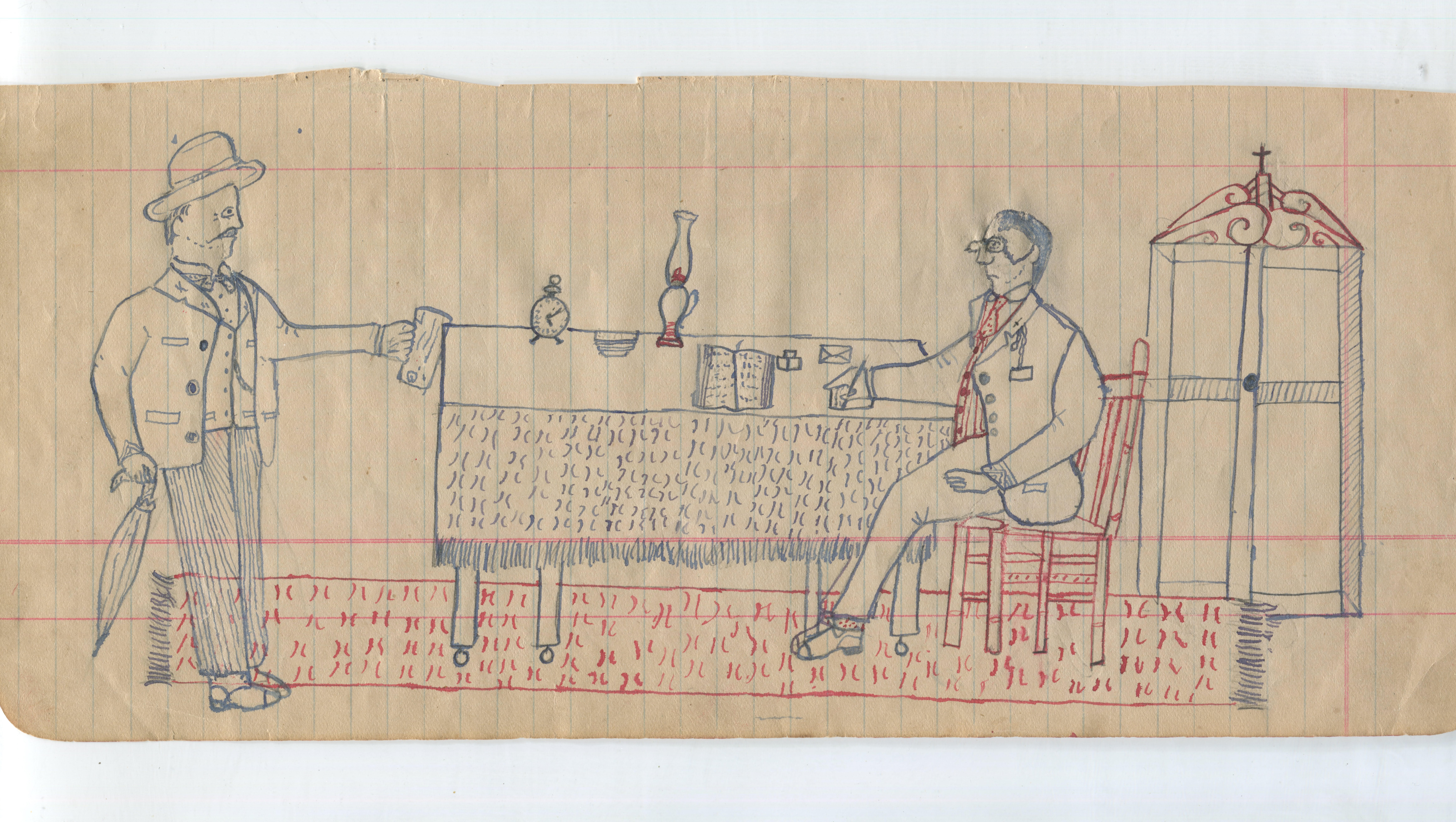
Detail only from a dated 1883 Fraktur drawing (with letter on reverse) from a gent to his wife. The portion shown is 1/4 of the piece, which is drawn throughout entirely in red and blue. Both parties are named, the piece is signed and I am researching the maker. "F L T" stand for "Friendship Love and Truth" a motif which is repeated. The piece also has an applied Victorian scrap affixed (surrounded by embellishment) and other decoration. A good find. Things ARE still out there. 19th Century Pennsylvania Fraktur collection Jim Linderman
SEE BOOKS (AND $5.99 ebooks) by Jim Linderman HERE
An original cabinet photograph of a hard and brutal life. Circa 1915 or so, location unidentified, of a group of coal miners and their four-legged helpers. Life is hard now, but it was worse back then. "Clean" coal is, of course, a massive misnomer. They can make "cleaner" coal burn better, but anything which puts the chemicals achieved through transforming combustion into the air is bad for our breathing. As one living with asthma, It is personal. If you have children with asthma, it is personal for you too. Not that the nuclear alternative is much better. I live an hour's drive from unarguably one of the worst and least safe Nuclear Reactors in the world. The Palisades. The plant has been generating "safely, reliably and cost-effectively since December 31, 1971" according to their WEBSITE. but it is pretty easy to dispute that. Fred Upton (Republican, Michigan's 6th District) is reportedly "outraged" by the latest spill of radioactive material into Lake Michigan from the plant, just one of a whole bunch of problems down there. They had five shutdowns in 2012 alone. There are only four plants with as bad a safety record in the country. Whether the congressman is outraged enough to return the $24,600 the owners of the plant Entergy donated to his recent campaign has not been reported.
Generating power which allows us the lifestyle to which we have become accustomed is fraught with unhealthy risk and involves hard decisions. 700 people work at that plant, and Upton knows it. He has to think of them and he has to represent his electorate.
We can ignore the problems associated with our energy choices, but we'll end up paying for it later, that you can be sure of. Original cabinet photograph, undated (circa 1915) collection Jim Linderman
Despite zoning regulations, I've put chickens in the yard, but they are my sister's. I am babysitting.
With European roots, and still carved over there are the wonderful wooden pecking chickens. Folk art in motion. Yard bird Peckers! The flat surface, or platform, is often "littered" with sawdust or specks of something resembling feed...wooden chickens are no smarter than the real ones, so they eat. Often the feed is painted on. Each bird is tied to a guide string which runs through the platform to a ball, which when rotated causes our favorite domesticated bird to move. Like a ping-pong paddle of peckers.
Although they are among the least expensive collectibles, one sold for over a grand at an auction a few years ago. It appears to have been a rare "dapple painted" Pennsylvania Dutch version. At any given time, you may find a dozen or so listed on eBay. There is endless variety, but they are all birds on a string. The most scarce are antique hand-made versions, or like all toys, those in the original box I suppose.. The ornate, painted versions imported from Russia are bright (and loud… clacking is an important consideration) but lack the charm of hand-carved or primitive rudimentary versions which are less decorative but more authentic. Can I just type "lacking clacking" once?
One of the earliest manufactured plastic versions is "Little Bill's Chickens" which is smaller than most and marked by title on the handle, and it is this one which originated in my family and is lovingly preserved by Lil Sis.
Essentially, there are three versions! The common pecking head, the less often seen bobbing tail, and the far more intricate version with flapping wings! Use above to create your own cottage coop industry. Collection of Pecking Chickens courtesy my Sister! BOOKS AND EBOOKS BY THE AUTHOR ARE AVAILABLE ON BLURB HERE
Jim Linderman Photo by Adam Bird for the New York Times
SEE ALSO Vintage Sleaze Art DAILY History Blog by Jim Linderman
Enticing Illustrators and Artists of the Past Discovered and Documented
ABOUT JIM LINDERMAN
Credits Biography Publications
ABOUT THE AUTHOR Jim Linderman
"...disclosing an underground history of American popular culture one oddball tale at a time" John Strausbaugh in The New York Times
"...one of the blog writers to watch for" ARTSlant
"Perpetually ahead of the collecting curve...a one man Taschen. An authentically curious individual...diligently archiving the forgotten curiosities of American History"
Emma Higgins in Art Hack May 2012
"...collected over the years by Jim Linderman, a character who seems the perfect subject for a Harvey Pekar comic. Linderman treats collecting like a calling, and his finds have a resulting air of authority, stunning in their capture of bygone picturesque moments." Derek Taylor Dusted
"The pictures, discarded artifacts of ecstatic Americana, come from the stash of Jim Linderman, who in his introduction recalls advice he’s plainly taken to heart: “Collect the heck” out of whatever you find interesting." Drew Jubera Paste Magazine
"His interest in art is rivaled only by his interest in music, and one expression informs the other. He pursues objects with thoroughness and an innate sense of curiosity..." Tanya Heinrich Folk Art Magazine
"Linderman acknowledges the obscure at the same time that he elevates it.... His collections tell vast stories in sotto voce, allowing curios and objects shadowed by mainstream culture and ideology to converse and be heard. What we hear is an enormous American sub-culture speaking in forbidden, marginalized languages: stuff discovered boxed in the attic out of embarrassment or zealotry, smutty ash trays crowing next to religious pamphlets, each claiming a part of the complex, sometimes contradictory, always conflicted American imagination, a chaos of memories that will one day vanish." Joe Bonomo Author of Conversations With Greil Marcus, Jerry Lewis Lost and Found and No Such Thing As Was
"...he's one of the world's greatest pickers." Brian Wallis in The New York Times
"Documenting--one clipping at a time--the scrapbook of a leg and garter aficionado that was dumpster-dived in Virginia in the 60s" "...an outstanding image-archaeologist who has compiled a shelf-ful of worthy and unique photographic histories." William Smith Hang Fire Books
"Linderman has a knack for discovering untold stories and introducing them to a wider audience" Joey Lin Anonymous Works
"Jim Linderman...makes us all look a little puny" Could it be Madness-this?
"...insatiable collector of ephemera and ringleader behind an incredible circus of blogs — including the treasure trove dull tool dim bulb" The Cynephile
"...there's something beyond the endless photos and postcards and weird propaganda from another time that he lovingly documents - I think it's the collection as a whole, the portrait of a person fascinated with culture and communication. I have met people like this before, and in reading Dull Tool Dim Bulb I feel I have been lucky enough to meet one more. This site is a goldmine in terms of links..." The Hyggelic Life October 2009
"Linderman is always on the lookout for the new and exciting" Chuck and Jan Rosenak Contemporary American Folk Art
"...an amazing collection..." Revel in New York October 2009
"Jim Linderman has a nice little colllection of interesting books and blogs...But every so often he just loses it." American Digest March 2010
"FOR MOST OF HIS LIFE, COLLECTOR JIM LINDERMAN has searched high and low for authentic things--unique and special objects that define the artistic culture of the American experience. From folk art to popular culture, from pulp fiction to Delta Blues-- Jim is a walking authority on so many things American they are too numerous to mention. One thing is certain-- his collecting interests are for things that have fallen through the cracks, those things lost and forgotten--the box of material under the table at the flea market booth. If it wasn't for dedicated collectors like Jim Linderman-- so many important objects about our culture would have surely been lost to time and indifference."
"Jim Linderman maintains a most interesting blog about the most amazing things from his collection—a site he calls “Dull Tool Dim Bulb,” the only curse words his father ever uttered. I love it, and read it everyday." "...an excellent writer and I devour your blog daily. I am impressed at your deep knowledge of things within your niche..." John Foster Accidental Mysteries
"I am grateful to Jim Linderman for first alerting me to the existence of the 1930s Spiritualist hymn "Jesus is My Air-o-plane." William Fagaly New Orleans Museum of Art, Author Tools of her Ministry: The art of Sister Gertrude Morgan
"Linderman describes a long gone world...(he) claims not to be a writer but he is most certainly an excellent researcher..." BOOKSTEVE
"Jim Linderman, King of the Internet Ephemeral Arts" Spaniel Rage
"Jim is a fantastic historian...show him some love" Astrid Daley Fringe Pop / Sin-A-Rama
"Almost an experimental narrative" Idiopath
"He came to us with hundreds of jaw-dropping baptism photos that he'd been collecting for 25 years," Ledbetter explains. "By the time he found us, he'd already done half a lifetime's works, and he trusted us to handle it properly." Lance Ledbetter in Creative Loafing 10/13/11